


 Language


PPTC Operating Principle
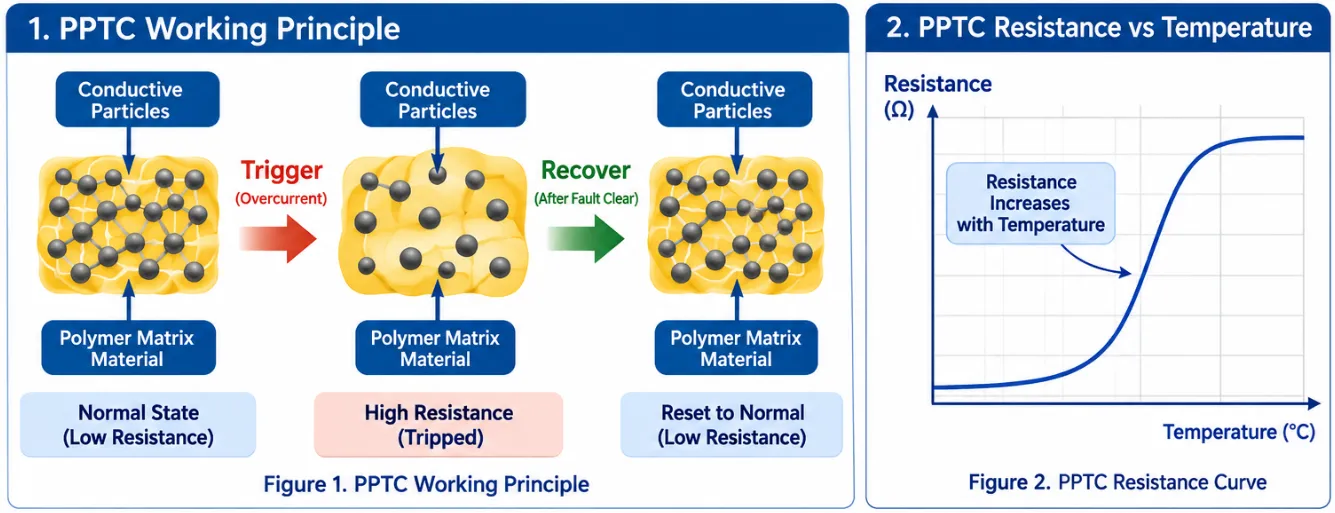
PPTC (Polymer Positive Temperature Coefficient) refers to the polymer positive temperature coefficient thermistor. As shown in Figure 1, a PPTC is composed of a polymer matrix and conductive particles. When an abnormal overcurrent flows through the PPTC, heat generated (I²R) causes the polymer matrix to expand. This separates the conductive particles dispersed within the polymer matrix, breaking the conductive paths and sharply increasing the resistance of the PPTC, which limits the abnormal overcurrent.
After the abnormal overcurrent fault is cleared, the polymer matrix of the PPTC contracts back to its original shape, reconnecting the conductive particles. The conductive paths are restored, and the PPTC returns to its original low-resistance state. This process can repeat many times.
Figure 2 shows the resistance-temperature curve of the PPTC. It can also be seen from the curve that the resistance of the PPTC rises as temperature increases. The internal temperature of the PPTC is determined by the current passing through it; therefore, the PPTC can also be described as a device sensitive to both temperature and current.
The most prominent feature of PPTC is that within its rated operating range, it does not need replacement after each fault is removed. It can be reused repeatedly in circuits, effectively saving maintenance time and costs.
FAQs
1. What is the working principle of a PPTC?
A PPTC (Polymer Positive Temperature Coefficient) works by using the thermal expansion characteristics of a conductive polymer composite. Under normal operating conditions, conductive particles form interconnected paths that allow current to flow with low resistance. When excessive current generates heat, the polymer matrix expands, separating the conductive particles and significantly increasing the resistance. This helps limit the abnormal current.
2. Why does the resistance of a PPTC increase when the temperature rises?
A PPTC contains a polymer matrix mixed with conductive particles. As the internal temperature increases, the polymer expands and disrupts the conductive particle network. This reduces the number of conductive paths and causes the resistance to rise significantly. This positive temperature coefficient characteristic enables PPTC devices to provide overcurrent protection.
3. Does a PPTC fuse need to be replaced after it trips?
Unlike conventional one-time fuses, a resettable PPTC is designed to recover after the fault condition is removed. Once the device cools down, the polymer matrix contracts and conductive paths are partially restored, allowing its resistance to return toward its initial low-resistance state. Under specified operating conditions, a PPTC can be reused multiple times.
4. How does a PPTC reset after an overcurrent condition?
When the excessive current is removed and the PPTC cools down, the expanded polymer matrix gradually contracts. Conductive particles reconnect, restoring conductive paths through the material. The resistance then decreases toward its original low-resistance state.
5. What causes a PPTC to trip?
A PPTC trips when excessive current generates enough internal heat to raise its temperature and resistance significantly. The actual trip behavior depends on several factors, including operating current, ambient temperature, device resistance, thermal conditions, and the PPTC's electrical specifications.
6. What is the difference between a PPTC and a traditional fuse?
A traditional fuse typically uses a metal element that melts when excessive current flows, permanently interrupting the circuit. A PPTC uses a conductive polymer composite whose resistance increases during an overcurrent event. After the fault is removed and the device cools, its resistance can recover, allowing the circuit to operate again without replacing the protection component.
7. Is PPTC resistance affected by ambient temperature?
Yes. Ambient temperature affects the operating temperature and resistance of a PPTC. At higher ambient temperatures, a PPTC may reach its trip condition at a lower current than it would under cooler conditions. Therefore, ambient temperature and thermal conditions should be considered when selecting a suitable PPTC component.
8. Can a PPTC be used repeatedly?
Yes. PPTC devices are designed for repeated reset and recovery cycles within their specified operating limits. However, repeated trips, excessive electrical stress, or operation outside the recommended ratings may affect long-term performance and service life. Proper component selection is essential.
About Ruilin Semiconductor
Ruilin Semiconductor is a manufacturer specializing in the research, development, and production of PPTC (Polymer Positive Temperature Coefficient) resettable fuses.
With a focus on PPTC technology and manufacturing, Ruilin provides a range of overcurrent protection components designed for different circuit protection requirements. Its product portfolio includes standard PPTC resettable fuses, ultra-low-resistance PPTC devices, high-temperature PPTC components, Type-C dedicated PPTC solutions, DIP PPTC products, and one-time fuse products.
Ruilin's PPTC product range covers various package sizes, including 0603, 0805, 1206, 1210, 1812, 2018, and 2920, supporting different applications and circuit design requirements.
By focusing on PPTC research, product development, and manufacturing, Ruilin Semiconductor aims to provide reliable overcurrent protection solutions for electronics manufacturers and customers worldwide.
For more information about Ruilin PPTC products, specifications, and customized protection solutions, please visit:
Website: https://www.ruilin-sz.com/